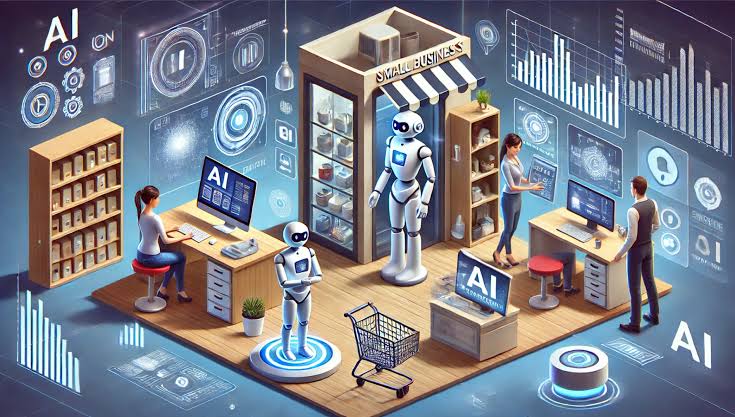
Artificial Intelligence (AI) has transformed from an emerging technology into a practical business tool that helps small businesses compete with larger organizations. Companies of every size are adopting AI-powered solutions to automate repetitive work, improve customer service, reduce costs, increase productivity, and make faster, data-driven decisions.
Today, AI is no longer reserved for large corporations with massive budgets. Affordable cloud-based platforms, intelligent automation tools, and machine learning applications have made advanced technology accessible to startups, entrepreneurs, local businesses, freelancers, and growing companies.
This comprehensive guide explores how AI is changing small businesses, the biggest advantages, real-world applications, challenges, implementation strategies, and future trends that every business owner should understand.
What Is Artificial Intelligence in Business?
Artificial Intelligence refers to computer systems capable of performing tasks that typically require human intelligence. These include:
- Learning from data
- Recognizing patterns
- Making predictions
- Understanding language
- Generating content
- Analyzing customer behavior
- Automating repetitive tasks
Instead of replacing business owners, AI enhances decision-making while allowing employees to focus on strategic and creative work.
Why Small Businesses Are Rapidly Adopting AI
Several factors have accelerated AI adoption among small businesses:
- Affordable subscription-based software
- Easy integration with existing tools
- Cloud computing
- Growing customer expectations
- Competitive pressure
- Improved data accessibility
Modern AI tools require little technical expertise, allowing even non-technical entrepreneurs to implement intelligent automation.
Top Benefits of AI for Small Businesses
1. Increased Productivity Through Automation
One of AI’s biggest advantages is automation.
Small businesses often operate with limited staff. AI automates repetitive tasks such as:
- Email responses
- Appointment scheduling
- Data entry
- Invoice generation
- Inventory updates
- Customer follow-ups
- Social media scheduling
Automation saves hundreds of work hours annually while minimizing human error.
2. Improved Customer Service with AI Chatbots
Customer support has dramatically improved through AI-powered chatbots.
These virtual assistants can:
- Answer frequently asked questions
- Track orders
- Recommend products
- Process appointments
- Collect customer information
- Resolve simple issues instantly
Unlike human agents, AI chatbots operate 24/7, improving customer satisfaction while lowering support costs.
3. Smarter Marketing Campaigns
Marketing has become significantly more effective through AI.
Businesses now use AI to:
- Analyze customer behavior
- Predict buying patterns
- Personalize emails
- Generate advertisements
- Write marketing content
- Optimize SEO
- Schedule campaigns automatically
AI identifies which campaigns perform best, helping businesses maximize marketing ROI.
AI-Powered Content Creation
Content marketing is essential for modern businesses.
AI assists with creating:
- Blog articles
- Product descriptions
- Email newsletters
- Video scripts
- Social media posts
- Advertising copy
- Website content
While human editing remains important, AI dramatically reduces writing time and improves productivity.
AI in Customer Relationship Management (CRM)
Managing customer relationships becomes easier with AI-enhanced CRM systems.
AI helps businesses:
- Score leads automatically
- Predict customer churn
- Recommend follow-ups
- Personalize communications
- Track customer preferences
- Improve sales forecasting
Sales teams spend less time organizing data and more time closing deals.
AI Helps Small Businesses Make Better Decisions
Business decisions are increasingly driven by data rather than assumptions.
AI analyzes:
- Sales performance
- Customer demographics
- Website traffic
- Marketing campaigns
- Inventory levels
- Seasonal demand
Instead of manually reviewing spreadsheets, business owners receive intelligent recommendations within seconds.
AI Improves Inventory Management
Inventory mistakes can significantly reduce profits.
AI helps businesses predict:
- Future demand
- Best-selling products
- Slow-moving inventory
- Seasonal purchasing trends
Accurate forecasting reduces overstocking and prevents stock shortages.
Financial Management Becomes Easier with AI
Accounting software now includes intelligent AI features that simplify financial operations.
Businesses use AI to:
- Categorize expenses
- Generate invoices
- Detect fraud
- Forecast cash flow
- Automate bookkeeping
- Identify unusual transactions
This improves financial accuracy while saving valuable administrative time.
AI Enhances Cybersecurity
Cybersecurity threats continue increasing each year.
AI helps protect businesses by:
- Detecting suspicious activity
- Monitoring network traffic
- Preventing phishing attacks
- Identifying malware
- Alerting unusual login attempts
Unlike traditional security systems, AI continuously learns from emerging threats.
Personalized Shopping Experiences
Modern consumers expect personalized experiences.
AI delivers personalized recommendations by analyzing:
- Purchase history
- Browsing behavior
- Customer preferences
- Shopping frequency
- Product interests
Personalization improves customer satisfaction while increasing sales conversions.
AI in Human Resources
Hiring the right employees becomes easier with AI.
Recruitment tools assist businesses by:
- Screening resumes
- Ranking applicants
- Scheduling interviews
- Identifying top candidates
- Reducing hiring bias
- Automating onboarding tasks
HR departments become more efficient while improving hiring quality.
AI Improves Email Marketing
Email remains one of the highest-converting marketing channels.
AI enhances email campaigns by:
- Personalizing subject lines
- Optimizing send times
- Segmenting audiences
- Predicting open rates
- Recommending products
- Writing personalized email content
Businesses achieve higher engagement with less manual effort.
AI for Social Media Management
Managing multiple social platforms is time-consuming.
AI simplifies social media by:
- Creating captions
- Scheduling posts
- Monitoring engagement
- Analyzing trends
- Responding to comments
- Suggesting hashtags
Businesses maintain consistent online visibility while reducing workload.
How AI Supports Local Businesses
Local businesses benefit significantly from AI.
Examples include:
Restaurants
- Online reservations
- Automated ordering
- Demand forecasting
- Menu recommendations
Retail Stores
- Inventory management
- Customer analytics
- Personalized promotions
Healthcare Clinics
- Appointment reminders
- Patient communication
- Medical documentation support
Real Estate Agencies
- Property recommendations
- Lead management
- Automated follow-up emails
Professional Services
- Scheduling
- Proposal generation
- Client communication
Challenges of AI Adoption
Although AI offers numerous benefits, businesses should prepare for several challenges.
Data Privacy
Businesses must securely handle customer information and comply with applicable privacy regulations.
Employee Training
Employees need proper training to maximize AI capabilities.
Continuous learning ensures successful implementation.
Integration Issues
Older systems may require updates before AI can integrate effectively.
Planning minimizes disruptions during implementation.
Initial Learning Curve
Although many AI platforms are user-friendly, businesses should expect an adjustment period before reaching maximum efficiency.
Best AI Applications for Small Businesses
Small businesses commonly use AI for:
- Customer support
- Marketing automation
- Accounting
- Data analysis
- Content writing
- Graphic design
- Email marketing
- SEO optimization
- Sales forecasting
- Inventory management
- HR recruitment
- Meeting transcription
- Document summarization
- Translation
- Workflow automation
Industries Experiencing the Biggest AI Transformation
AI is reshaping nearly every industry.
These sectors are seeing the greatest impact:
- Healthcare
- Retail
- Finance
- Manufacturing
- Education
- Construction
- Hospitality
- Transportation
- Real Estate
- Legal Services
- Marketing Agencies
- E-commerce
How to Successfully Implement AI in Your Small Business
Businesses achieve the best results by following a structured approach.
Identify Repetitive Tasks
Start with processes consuming excessive employee time.
Choose One AI Tool First
Avoid implementing multiple systems simultaneously.
Train Employees
Help staff understand AI features and best practices.
Measure Performance
Track productivity improvements and customer satisfaction.
Expand Gradually
After early success, introduce AI into additional business functions.
The Future of AI for Small Businesses
AI technology continues advancing rapidly.
Future developments will include:
- More intelligent virtual assistants
- Advanced predictive analytics
- Hyper-personalized customer experiences
- Autonomous workflow management
- Voice-controlled business operations
- AI-powered strategic planning
- Smarter cybersecurity
- Enhanced financial forecasting
- Real-time business intelligence
As costs continue declining, AI will become a standard business tool rather than a competitive advantage.
Common Mistakes to Avoid When Using AI
Many businesses fail to maximize AI because they:
- Expect immediate results
- Ignore employee training
- Neglect data quality
- Over-automate customer interactions
- Choose overly complex software
- Fail to monitor AI performance
- Ignore customer feedback
Avoiding these mistakes leads to better long-term success.
Conclusion
Artificial Intelligence has become one of the most powerful technologies available to small businesses. By automating repetitive work, improving customer experiences, enhancing marketing, strengthening cybersecurity, optimizing inventory, streamlining financial management, and supporting smarter decision-making, AI enables smaller organizations to compete more effectively in increasingly competitive markets.
Businesses that adopt AI strategically can improve operational efficiency, reduce costs, increase revenue, and deliver more personalized customer experiences without dramatically increasing staffing or overhead. The most successful organizations will combine human expertise with intelligent automation, creating faster, smarter, and more scalable operations.
Rather than replacing people, AI empowers teams to focus on innovation, creativity, relationship building, and long-term growth. As AI technology continues evolving, small businesses that embrace these innovations today will be better positioned to thrive in the digital economy of tomorrow.